


Brazil and Saudi Arabia expand cooperation in mining
15 de January de 2026
Brazil and Russia strengthen broad long-run partnership
8 de February de 2026
With 10 finalists, award strengthens cultural exchange, translation of works and creative cooperation among member countries.
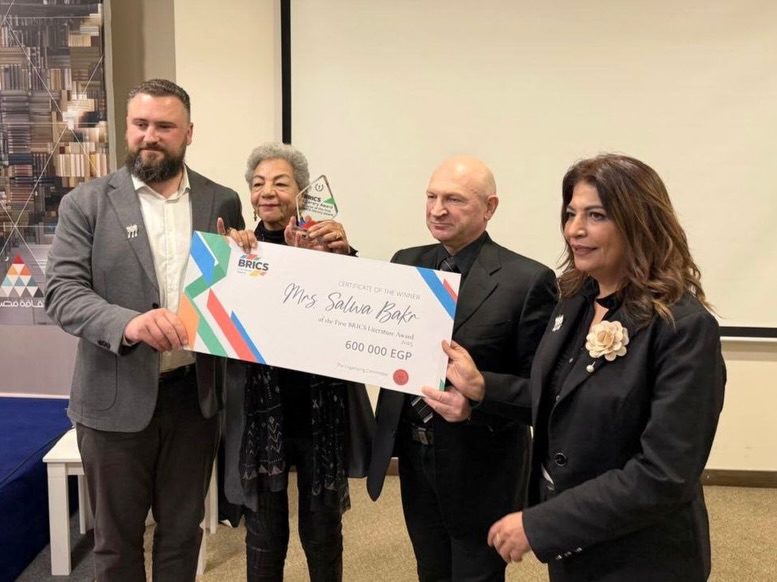
Egyptian literature gained international prominence with the victory of Salwa Bakr in the first edition of the BRICS Literature Prize, presented on January 24, 2026, during the 57th Cairo International Book Fair.
Created in 2024, the prize was established with the aim of consolidating a shared cultural space among the bloc’s countries, expanding dialogue among diverse literary traditions.
The award was presented by Aleksandr Ostroverkh-Kvanchiani, executive director of the initiative and director of the Eurasian Foundation for Humanitarian Values. The winner received 600,000 Egyptian pounds, approximately US$ 13,000.
In addition to Salwa Bakr’s victory, Indonesian writer Denny JA received the special prize for “Innovation in Literature” for creating the poetic essay — a genre that combines imagination, facts and documentary materials. The style is regarded as an innovative form of literature that brings together artistic and research approaches, opening new possibilities for interpreting contemporary reality.
One of the most significant aspects of the prize is that it provides for concrete measures: the winners’ works will be translated into 10 languages. Publication of Salwa Bakr in Russian by AST, one of Russia’s largest publishing groups, has already been announced.
It is worth noting that Brazilian writer Ana Maria Gonçalves was the Brazilian finalist in the award, which brought together contemporary authors from 10 BRICS+ countries.
Salwa Bakr: about the winner
Salwa Bakr is considered one of the leading contemporary authors writing in Arabic. She is the author of seven novels, seven short story collections and one play. Her works have been translated into several languages, including European languages.
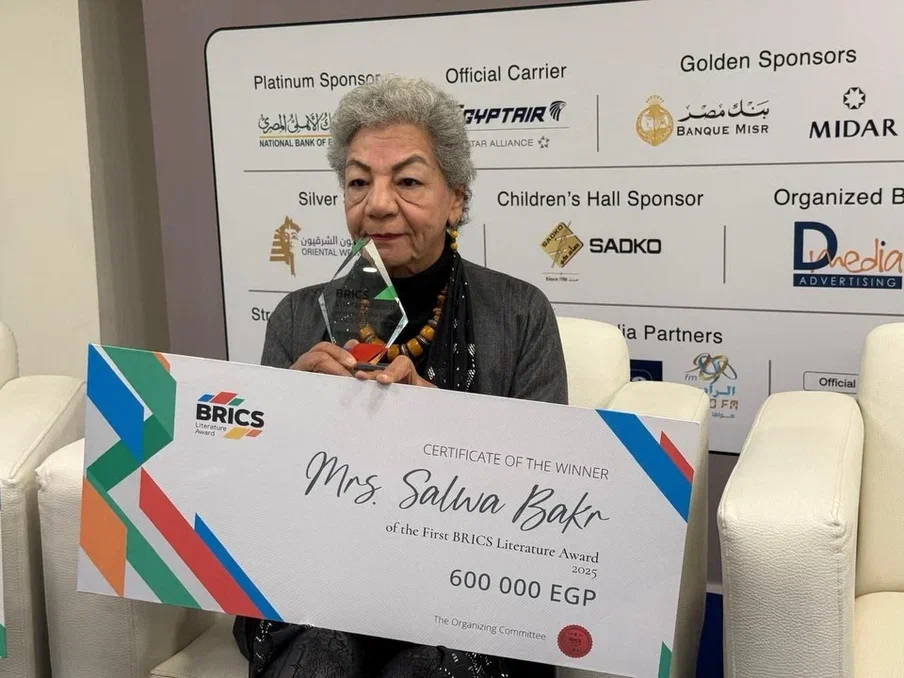
“Ancient Egypt was developing literature at a time when Europe was living through the Dark Ages, while Russian culture and Russian literature are among the deepest in terms of their impact on the world. Our consciousness was nourished by the great Russian literary legacy of Chekhov, Dostoevsky, Maxim Gorky and a whole constellation of brilliant writers, alongside authors from India, China, Brazil and other countries.”
Salwa Bakr – Writer and Novelist
After receiving the prize, Salwa emphasized that BRICS, beyond being a “civilizational alliance”, has for decades contributed to the formation of a global humanist culture.
Read impactful quotes
According to the organizers, Salwa Bakr reinforces the cultural dimension of cooperation among BRICS countries and highlights the role of Egyptian literature in building this humanist space on a global scale.
“For Egypt, it is a great honor that it is precisely our writer who becomes the first laureate of the BRICS Literature Prize. This is not merely news about an award — it is a sign that contemporary Egyptian prose is being heard and understood far beyond our country’s borders. Salwa Bakr is an author with a very distinctive and free voice, who reveals to readers the real and living Egypt.
Her victory shows that, within BRICS, the conversation is not limited to politics and economics; a common cultural space is taking shape here, where our stories, our languages and our values are heard on equal footing. I am certain that this first success will be followed by new names and new achievements of Egyptian literature within BRICS.”
Doha Mostafa Assi – Member of the Egyptian parliament and one of the founders of the prize
“The BRICS Literature Prize is an opportunity for writers to enter into a living dialogue with readers around the world, present to them the culture of their own country and gain new recognition. The prize helps to reveal new literary names worthy of attention and also provides for the translation, publication and promotion of works in the languages of BRICS countries.
We are discovering authors who deserve a global audience and at the same time building for them a concrete path to projection — both within the BRICS space and in countries willing to share our values.”
Aleksandr Ostroverkh-Kvanchiani – Executive director of the BRICS Literature Prize and director of the Eurasian Foundation for Humanitarian Values
“The BRICS Literature Prize has already become an instrument for encouraging translation. Soon, the KPD project by Zakhar Prilepin of the AST publishing group will publish this year’s winner, Salwa Bakr, in Russian. We need to return to one another the richness of our cultures, and the greater objective of the prize remains the search for shared values of the global majority in order to strengthen and develop our cooperation.”
Dmitry Kuznetsov – Deputy of the State Duma of Russia, member of the Committee on International Affairs and head of the Secretariat of the BRICS Literature Prize
“We hope that for Salwa Bakr and Denny JA this prize will mark the beginning of a long and successful journey in the world of literature, as well as a prologue to recognition not only in BRICS countries but across the world. Their books will be translated into 10 languages, enabling millions of new readers to discover these names.”
Vadim Teryokhin – Co-chair of the Writers’ Association of the BRICS Literature Network
 Development of the BRICS literature network
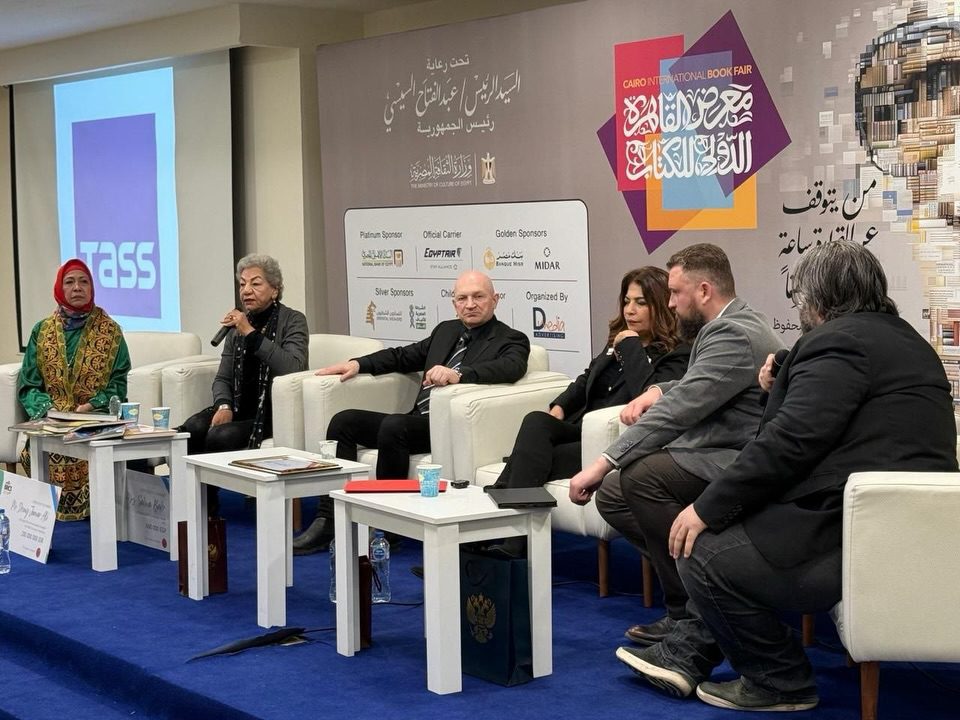
Vadim Teryokhin further noted that the BRICS Literature Network has evolved into a platform for dialogue:
“Each member country has brought its voice to the debate on the paths of development of world literature, and many friendly countries — which are not formally part of BRICS but share our values — are already showing interest in our initiative”, he said.
Finally, pointing to the growing trend of cultural diplomacy, the organizer stated that the initiative has laid the groundwork for the future expansion of the network and for the mutual and profound enrichment of literatures through the artistic word.
See also