



BYD invites João Vitor de Paiva to visit China
1 de June de 2026
Essential Guide to Critical and Strategic Minerals
11 de July de 2026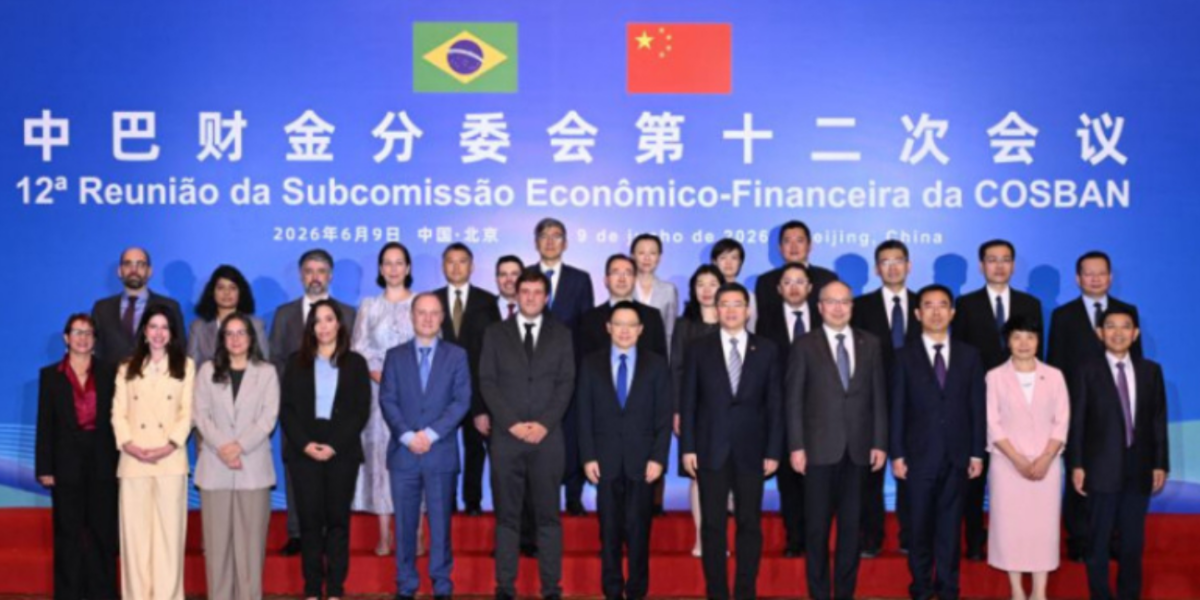
Meeting in Beijing reinforces the importance of the partnership as one of the most relevant in the Global South amid global uncertainties.
On Tuesday, June 9, 2026, Brazil and China held key meetings in Beijing to deepen their bilateral strategic partnership. The agenda covered topics such as finance, investments, trade in local currencies, issuance of sovereign bonds, green economy, multilateralism, among other issues.
The Brazilian delegation continues its official commitments in China until Thursday, June 11. Below are some highlights released so far by the Chinese portal Global Times.
Historic leap in Brazil-China relations
The Brazilian delegation participated in the 12th Meeting of the Financial Sub-Commission of the China-Brazil High-Level Coordination and Cooperation Commission. The meeting was led by China’s Vice Minister of Finance Liao Min and by Mathias Alencastro, Secretary for International Affairs at Brazil’s Ministry of Finance.
Liao Min stated that, under the strategic guidance of the leaders of both countries, Brazil-China relations have achieved a historic leap and that broad cooperation has continuously improved in quality and level.
“China is willing to work with Brazil to strengthen communication and coordination on macroeconomic policies, deepen practical bilateral financial cooperation, and enhance coordination and cooperation within multilateral mechanisms, so as to inject more certainty into a turbulent world through our own stable economic development.”
Liao Min – Vice Minister of Finance of China
For his part, Mathias Alencastro highlighted the importance of Brazil-China cooperation amid international uncertainties. He emphasized that the country seeks to deepen mutual trust, achieve reciprocal benefits and raise bilateral financial cooperation to new levels, while strengthening coordination on the international stage.
Brazil and China discussed cooperation in banking, insurance, capital markets, trade and agricultural financing, sustainable investment and multilateral finance.
Central Banks: advances in local currencies
In a parallel meeting, the presidents of the central banks of Brazil and China – Gabriel Galípolo and Pan Gongsheng – addressed measures to facilitate trade:
- Facilitation of opening local-currency accounts by companies from both countries;
- Expansion of the scope of bilateral local-currency swaps;
- Study for the implementation of direct Yuan/Real trading;
- Strengthening of local-currency payment systems to provide efficient and secure payment and settlement services in bilateral trade.
Panda bonds and investments
China welcomed the issuance of Brazilian sovereign bonds in the Chinese market, known as Panda Bonds, and encouraged more high-quality Brazilian companies to issue bonds in the country.
In addition, both sides announced support for the pilot program China-Brazil Bond Connect – a system that facilitates the purchase and sale of public and private bonds between the Chinese and Brazilian markets.
They also encouraged the China-Brazil Fund, a bilateral investment fund aimed at financing projects in Brazil, with a focus on infrastructure, energy, agriculture and green transition.
Sustainable agriculture and green economy
Brazil plans to expand bilateral cooperation in sustainable agriculture, green transformation and the economy of the future. To this end, the China-Brazil Agricultural Financing Cooperation Working Group will be used to bring together financial institutions and market players from both countries.
International coordination
As key members of the Global South, China and Brazil reaffirmed their commitment to strengthening coordination in the financial track of the G20, BRICS, the AIIB (Asian Infrastructure Investment Bank) and the NDB (New Development Bank).
Together, the countries intend to promote the reform of global economic governance and boost the development of sustainable infrastructure in the Global South.
- Follow my updates in real time on X: @sitebricsbrasil
- Photo credit: Global Times/Ministry of Finance of China