


COP 30: Climate Summit begins in Brazil, bringing together 57 nations
6 de November de 2025
Ecotourism: Brazil launches 468-km Amazon Atlantic Trail
16 de November de 2025
Launched at COP30, the TFFF inaugurates a new global model for financing the preservation of tropical forests.
The Tropical Forests Forever Facility (TFFF) was officially launched during COP 30 in Belém city (Pará state – Brazil). The initiative opens a new chapter in environmental diplomacy by bringing together governments, development banks, international institutions and private investors to support and finance countries that conserve and restore their tropical forests, while promoting the sustainable use of natural resources.
“Tropical forests play an essential role in tackling climate change. They store carbon, maintain water flows and safeguard biodiversity. Without them, we have no water to drink or to grow crops. When forest destruction reaches irreversible levels, the consequences are felt across the world. Forests are worth more standing than cut down and they should be included in the GDP of our countries. The ecosystem services that forests provide to humanity must be valued — as must the people who protect them.”
President Lula
🌐 What is the TFFF
The TFFF is a permanent international fund that allocates resources to nations with tropical forests such as Brazil, Colombia, Peru, Indonesia, Congo, Ghana, among other tropical countries.
Its proposal is simple and innovative: those who conserve, receive. Countries are rewarded based on verified results, confirmed through satellite imagery showing reductions or stability in deforestation rates.
The goal is to transform forest conservation into a stable and lasting financial flow, recognising that forests provide essential global services — climate regulation, the water cycle and biodiversity — which benefit all countries.
💰 How the fund operates
The TFFF will adopt a result-based payment model:
- Countries that reduce deforestation below pre-established targets will be financially rewarded.
- Targets and results will be monitored using satellite imagery and assessed annually.
- Reforestation and regeneration efforts will also be taken into account.
- Funds will go directly to national governments, enabling sovereign programmes (that is, managed by the countries themselves) for the long term, focused on bioeconomy, reforestation and the protection of local communities.
💡 Why the TFFF is innovative
The TFFF represents an innovation in climate policies that, until now, relied largely on donations.
The fund creates an investment model with both financial and environmental returns, built on three key pillars:
- A common global metric: based on satellite monitoring and deforestation indicators.
- Clear economic incentives: the more forest preserved, the greater the return.
- Climate justice: compensation directed to countries and peoples that protect nature.
“This is the COP of implementation.
The TFFF turns promises into concrete action.”
Marina Silva – Minister of the Environment and Climate Change
🧩 Who participates
The TFFF brings together a broad network of participants:
- Governments: tropical forest countries and investor nations.
- International financial institutions: which structure and manage the fund.
- Private companies: that invest resources and take part in sustainable projects.
- Multilateral organisations: such as the UN and UNDP, which contribute to governance and result verification.
- Indigenous peoples and local communities: direct beneficiaries and guardians of the forests.
🌳 Forest-based people at the heart of it all
The TFFF stipulates that at least 20% of the resources from each participating country must be directed to Indigenous peoples and traditional communities, who are, in practice, the main guardians of the forests
“Caring for rubber tappers, extractivists, women and Indigenous peoples is caring for the forests”, said Lula. The Minister of Indigenous Peoples, Sonia Guajajara, also emphasised that local communities played an active role in designing the TFFF model.
🏛️ Governance and transparency
The fund also innovates in its governance structure. The TFFF’s decision-making bodies will have equal representation between investor countries and countries that hold tropical forests.
There will be social, scientific and independent expert participation to monitor and enhance the mechanism.
The World Bank will host the Interim Secretariat and support the fund’s financial structure, while regional banks — such as the New Development Bank (NDB) and the African Development Bank (AfDB) — are negotiating future participation.
This shared governance ensures legitimacy and efficiency, reducing bureaucracy and ensuring that funds reach those making a difference on the ground.
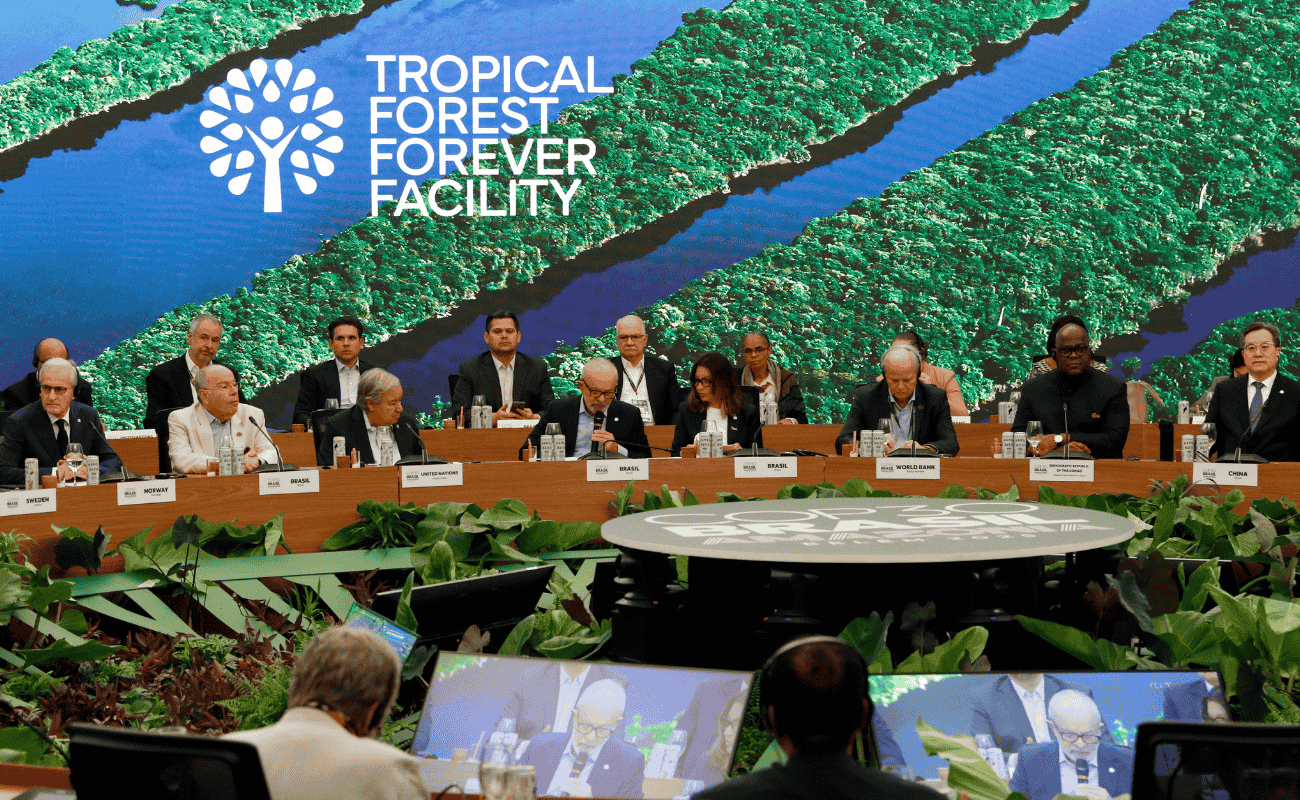
Climate Summit in Belém (Credit: Bruno Peres – Agência Brasil)
🤝 Participating countries and next steps
The TFFF was launched with the support of the world’s three major tropical forest regions — the Amazon, Congo Basin and Borneo-Mekong.
Brazil was the first to make a financial contribution and has been a leading partner in the fund, alongside other nations with vast tropical forest areas.
The initiative already has the support of more than 50 countries. Among the first participants are Brazil, Norway, Indonesia and France, which together have already raised more than US$ 5.5 billion. Several others — including Germany, the United Kingdom, the United Arab Emirates and the European Union — have expressed interest in joining.
The expectation is that the fund will mobilise large-scale public and private resources and become a lasting instrument of South–South and North–South cooperation, recognising the economic and climate value of tropical forests.
“For the first time in history,
countries of the Global South will lead a forest agenda.”
President Lula
🌱 What will be financed
TFFF investments will prioritise sustainable activities that combine income generation with environmental conservation, focusing on measurable results in the preservation and recovery of tropical forests.
Funds may support national programmes and policies aimed at sustainable forest use, the promotion of the bioeconomy and the strengthening of local communities, according to criteria and goals established by the fund itself.
🌎 A legacy born in the Amazon
In brief, tropical forests are essential to the balance of the planet. They regulate the global climate, sustain the water cycle that supports agriculture, store carbon and shelter millions of species and traditional communities.
When a country preserves its forests, the whole of humanity benefits. The Tropical Forests Forever Facility is based on the principle of shared responsibility: those who protect the climate deserve to be rewarded.
The launch in Belém symbolises the Global South’s leadership in this new forest agenda. On X, President Lula summed up the symbolism of the TFFF’s birth in Belém, “surrounded by sumaúmas, açaí palms, andiroba trees and jacarandas”:
“In a few years, we will see the fruits of this fund and take pride in remembering that it was in the heart of the Amazon Rainforest that we took this step together. As Brazilian environmentalist Chico Mendes said: ‘At first, I thought I was fighting to save rubber trees; then I thought I was fighting to save the Amazon rainforest. Now I realise I am fighting for humanity.'”
President Lula
Get to know more