


Oil shock: is the worst still ahead?
14 de May de 2026
BYD invites João Vitor de Paiva to visit China
1 de June de 2026
Working group has 90 days to propose program turning mineral wealth into technology, industry and sustainable development.
This month, the Brazilian government established a working group named GT Soberania Tecnológica Nacional – Inovação para o Setor Mineral (National Technological Sovereignty Working Group – Innovation for the Mineral Sector). Linked to the Ministry of Science, Technology and Innovation (MCTI), the group is responsible for drafting the proposal for the Inova+Mineral Program.
It comprises five institutions:
- Finep (Brazilian Funding Authority for Studies and Projects)
- CNPq (National Council for Scientific and Technological Development)
- Embrapii (Brazilian Company for Industrial Research and Innovation)
- Cetem (Center for Mineral Technology)
- CGEE (Center for Management and Strategic Studies)
The ABCs of Minerals
Before proceeding, it is worth clarifying some terms that often cause confusion. The expression “critical and strategic minerals” serves as an umbrella term for several materials essential to the modern economy:
- Critical minerals = high risk of supply shortages (few countries dominate global production).
- Strategic minerals = vital for national sovereignty, electric vehicles, electronics, defense and high-tech industries.
Within this macro category we find:
-
- Rare earths: 17 different chemical elements, used mainly in renewable energy (wind turbines), electric mobility (electric vehicles), electronics (cell phones, screens, chips), defense (military equipment) and industry.
- Lithium: the main ingredient in rechargeable batteries for cell phones, laptops and electric vehicles.
- Niobium: Brazil is the world leader; it enhances metal alloys for the aerospace, oil and gas (pipelines) and high-strength construction sectors.
- Others (such as graphite, cobalt, nickel, copper, titanium and silicon): each with specific roles in batteries, electronics, electrical wiring, solar panels, medical equipment and many other applications.
Together, they represent the raw materials of the 21st century. Mastering their production is one of Brazil’s key national strategies.
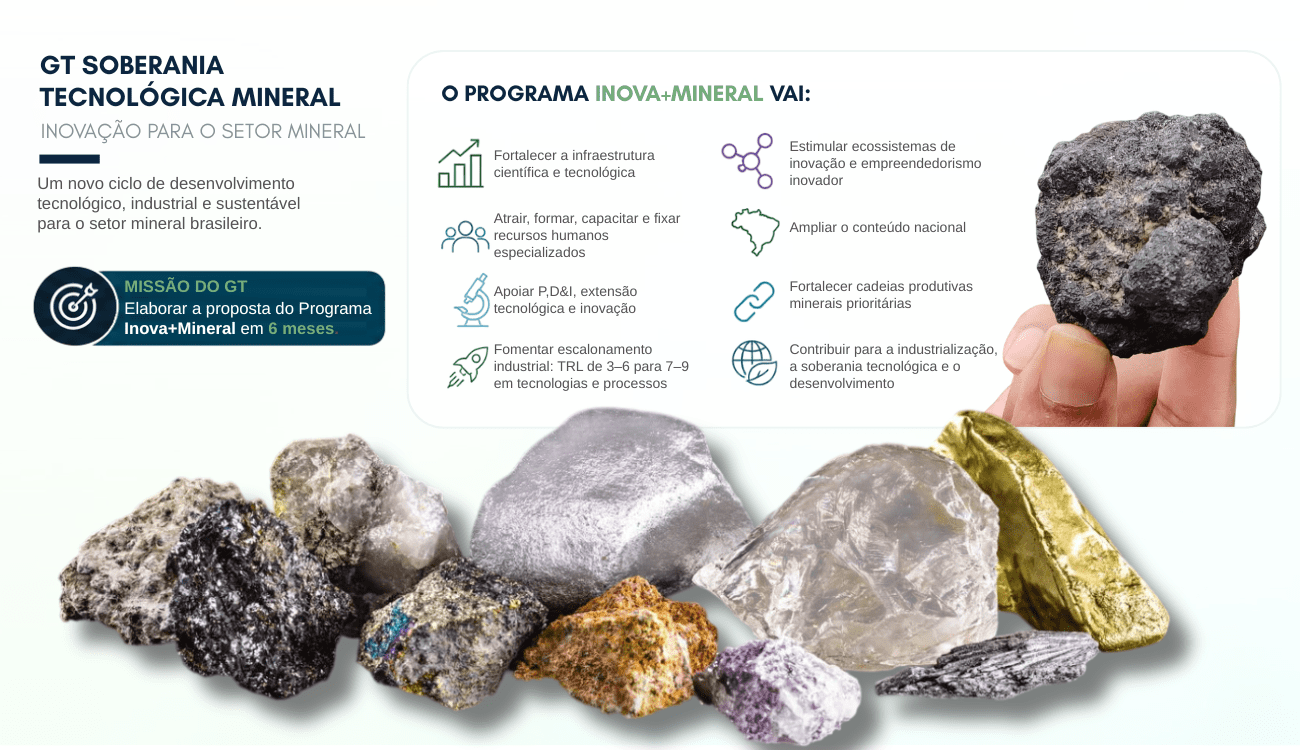
Source: Ascom and MCTI (click to enlarge)
Current stage of Brazil
The country currently occupies the initial stage of the mineral value chain: it exports raw ore and imports high-technology products — such as magnets, batteries, semiconductors and components for the defense industry.
“Brazil cannot accept the role of exporting raw ore and importing expensive technology. We have the intelligence, institutions and productive capacity to move forward.”
Luciana Santos – Minister of Science, Technology and Innovation
The creation of the GT therefore represents the decision to move to the next phase: technological mastery, local refining and domestic manufacturing of critical and strategic inputs.
Data, numbers and investments
Investments are already underway. Between 2023 and 2025, Finep contracted more than 5,300 research, development and innovation (R&D&I) projects. The total volume reaches R$ 45 billion — a 235% jump compared to the previous period.
For the mineral sector, there is a specific funding line. The Finep Mais Inovação Brasil – Transformação Mineral call offers R$ 200 million in non-reimbursable resources for companies. The priorities of the call are divided into two fronts:
- Priority minerals: Lithium, copper, nickel, graphite, rare earths, niobium, silicon, cobalt and titanium.
- Sustainable technologies:
- Urban mining (recycling of electronic waste)
- Decarbonization
- Low-emission hydrogen
- CO₂ capture
In addition, Brazil already has 22 National Institutes of Science and Technology (INCTs) linked to mining, 58 Embrapii units working on mineral transformation and 96 Local Productive Arrangements (APLs) of mineral base spread across the country.
Next steps
In the next 90 days (extendable for a similar period), the working group will deliver a concrete program that will:
- Map which critical and strategic minerals are priorities for Brazil.
- Identify technological bottlenecks (for example, which stages of rare earth refining we still do not master and how to overcome them).
- Propose targets for industrial scaling (that is, taking technologies that today exist only in the laboratory to commercial-scale production).
- Define training programs for engineers, chemists and technicians specialized in mineral processing.
- Create continuous financing mechanisms so that Brazilian companies can develop their own solutions, reducing dependence on imports.
Conclusion: Brazil’s potential is immense
Brazil brings together extraordinary conditions on the global stage: it is the world’s second-largest holder of rare earth reserves, leader in niobium and holds a prominent position in graphite and lithium. The country is now beginning to build the bridge between subsurface wealth and technology.
With record investments, a consolidated scientific base and a working group dedicated exclusively to this leap, the outlook is promising. Inova+Mineral seeks to position Brazil as a supplier of technological and industrial solutions to the world as well — generating qualified jobs, foreign exchange and sovereignty.
The first step has been taken. The direction is clear and the country has everything it needs to lead the next frontier of critical and strategic minerals, transforming the course of its history.
See also
- 100 ideas for Brazil to lead in critical minerals and rare earths
- Stay updated with my real-time posts on X: @sitebricsbrasil